Hellenic Heritage

Our Heritage

Explore the people, places and historical traditions that have shaped the Greek Macedonian heritage at the heart of our Association.

From our historical collection

The Land of Philip & Alexander

This section presents historical material carried forward from the Association’s earlier publications, alongside selected heritage topics and imagery.

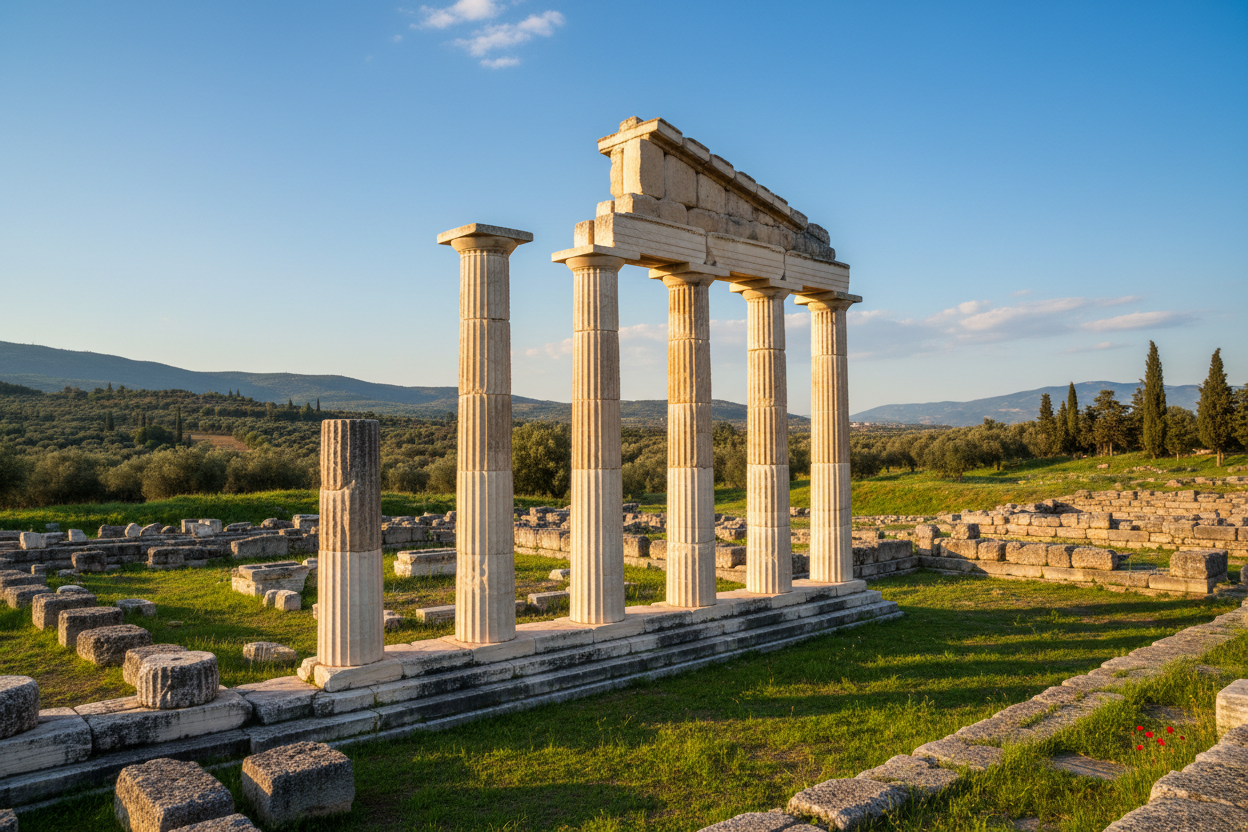
Illustrative view of Greek-inspired ancient ruins
01 / Ancient Macedonia

Origins, kings and culture

Ancient Macedonia, the land of Philip and Alexander, stretched on the north along the lines drawn between Ohrid — Prilep (Pelagonia), followed the flow of Crna Reka to Demir Kapija to the Mt. Orvylos (Macedonian Paeonia), to Mt. Rhodopi following the flow of River Nestos to the Aegean Sea.

Read the full historical account

The original Macedonians, the Macedonian Greeks arrived in the area around 2000 BC and they were descendants of the Heracleides. As such the ancient Macedonians were part of a larger and the last group of Greeks, which reached the area of present day Kastoria (Orestis) along with the Dorians, Acarnanians and Aetolians around 2000 BC. Herodotus, the father of history, describes the 800-year wanderings of that large group, which eventually split into three smaller groups. Just after the Trojan War, the first group under the leadership of Dorus inhabited Peloponnesus and the second group, the Acarnanians and Aetolians, went south. The third group marched east and by pushing the Phrygians, established the Kingdom of Macedonia on a loop of the River Aliakmon. The first king of Macedonia was Karanos who reigned between 813 and 786 BC.

The first capital of Macedonia was Aiges but later King Archelaus (413–399 BC) moved the capital to Pella, which had direct access to the sea by way of the river Lydias. During the time of King Philip II, 359–336 BC, Macedonia became one of the great powers of Europe. King Philip II was successful in uniting the Greek city-states under a Pan-Hellenic Union, which was essentially the Greek nation as we know it today. Philip II in 337 BC and his son Alexander in 335 BC were chosen as the Commanding Generals of all Greeks except the Spartans in the Council of Corinth. Alexander III, also known as Alexander the Great, 336–323 BC, while the Commander General of all Greeks conquered most of the known world of his time, spreading the Greek language and tradition in the lands he conquered.

02 / Through the centuries

From Rome to Byzantium

During the Roman Conquest, which continued into the Byzantine Era — a period of about one thousand years — that Roman territory with Constantinople as its capital and Thessaloniki as a cultural and commercial center of the Empire, remained fully Greek. Furthermore during Justinian’s time it adopted the Greek language as the formal and official language of the Byzantine State.

Read the full historical account

Macedonia was invaded several times from the north from the third to the fourteenth centuries AD. As a result of these invasions, the Bulgarians established in the summer of 681 AD. A tremendous attempt to gain Hellenic territories took place at the end of the 10th century AD by the Bulgarian king Samuil, whose army was annihilated at Kleidion (Belasica), close to Strumica on July 29, 1014. For his cruelty the conqueror, Emperor Basil II of the Macedonian Dynasty, was given the infamous name, “the Bulgar-slayer.” It was during this time that the Ottoman Empire was organized, and by the fifteenth century Thessaloniki (1430) and Constantinople (1453) followed the rest of the Balkans and Asia Minor by falling into the hands of the Turks.

The White Tower of Thessaloniki
Ancient mosaic of Dionysos and panther, Pella
03 / A living heritage

Tradition, struggle and continuity

During the Turkish Occupation, Macedonia preserved its Greek identity, in perpetuity, through Greek language, religion and culture. Greek schools were allowed to open and function in Thessaloniki, Kozani, Siatista, Naoussa, Veroia and Serres, as was the case in the rest of Greece. When Turkish rule made this impossible, schools functioned secretly in the churches. In 1904 a systematic guerrilla effort on the part of the Macedonians with considerable ammunition and troops from the free Greeks started the Macedonian Struggle, which ended in 1908 with the “Young Turk” movement in Turkey. Many glorious figures emerged from the Macedonian Struggle, among them Pavlos Melas, Germanos Karavangelis, Ion Dragoumis, Kotas, Lambros Koromilas, Constantine Mazarakis, and Telos Agras.

Read the full historical account

The eventual union with free Greece saved Macedonia from falling into the hands of the Slavs during the Balkan Wars (1912–13). The struggle against the Ottoman occupant began in 1821 in southern Greece and that part of the Greek world was finally liberated in 1832. During the Balkan Wars of 1912–13, Greece liberated its province of Macedonia, as well as other Greek regions from the Ottoman rulers.

Key Moments in Macedonian History

Pillars of Our Heritage

Tap any topic to explore the full story — from the founding kings to the spread of Hellenic culture across the known world.

Image information and credits

The ancient ruins landscape is illustrative artwork, not an archaeological photograph. The Thessaloniki image is sourced from Wikimedia Commons. The Pella mosaic photograph is credited to Fingalo / Wikimedia Commons (CC BY-SA 2.0 DE).

Setting the Record Straight

Facts & Fallacies

Explore the Association’s historical material addressing claims and debates concerning Macedonia’s Hellenic heritage.

There have been certain fallacies circulating for the past few years due to ignorance on the “Macedonian Issue”. It is exacerbated by systematic propaganda emanating from AVNOJ or communist Yugoslavia and present-day FYROM, and their intransigent ultra-nationalist Diaspora.

This material forms part of the Association’s long-standing educational and advocacy work concerning Macedonian Hellenic heritage. It is presented here as Association material and should be read in that context.

base44
Edit with Base44
